
This is our MVHR Flow Rate Testing Checklist for Part F Building Regulations for MVHR Systems in New Homes and Residential Developments.Mechanical Ventilation with Heat Recovery (MVHR) systems must be independently tested and commissioned to demonstrate compliance with Part F (Ventilation) of the Building Regulations. The final ventilation flow rate test confirms that the installed system achieves the design airflows specified by the designer and manufacturer and provides adequate indoor air quality for occupants. The ventilation requirements are set out within Approved Document F.
At APT Sound Testing, we regularly find that many MVHR systems fail the flow rate test because simple installation or commissioning issues have not been resolved before the testing engineer arrives.
Please book your MVHR testing appointment to maximise the chances of achieving a first-time pass.
Get a Part F MVHR Flow Rate Testing Quote ▶
Why is MVHR Flow Rate Testing Required?
MVHR flow rate testing verifies that:
- Supply air is delivered to habitable rooms.
- Extract air is removed from wet rooms.
- The system achieves the required design airflow rates.
- The installation complies with Part F Building Regulations.
- Building Control receives independent verification of compliance.
- Homeowners receive a properly balanced and functioning ventilation system.
For the latest Government guidance, see:
- Approved Document F (Ventilation)
- Approved Document F: Volume 1 (Dwellings)
- Existing Home Ventilation Guide:
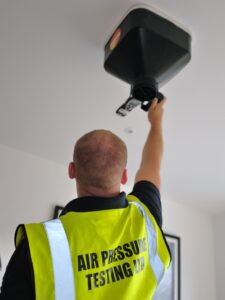
MVHR Testing Checklist
✅ 1. Is the MVHR Unit Fully Installed?
Before carrying our the air flow testing:
- MVHR unit securely mounted.
- Electrical connection complete.
- Permanent power available.
- Unit switched on and operational.
- No fault lights or error codes present.
- Internal filters installed correctly.
Common failure issue:
❌ Unit still in commissioning mode or not operating at intended speeds.
✅ 2. Is the Ductwork Installation Complete?
Ensure the ductwork has been correctly installed inline with the following:
- All ductwork installed.
- Ductwork connected to MVHR unit.
- No disconnected branches.
- No crushed flexible ducting.
- No damaged rigid ductwork.
- Duct insulation completed where specified.
Common failure issue:
❌ Kinked ductwork significantly restricting airflow.
✅ 3. Is the Air Valves Installed?
Before carrying our the air flow testing:
- All supply valves fitted.
- All extract valves fitted.
- Valve locations match design drawings.
- Ceiling plenums complete.
- No temporary caps or coverings in place.
Common failure issue:
❌ Missing extract valves throughout kitchens and bathrooms.
✅ 4. Is the Property Fully Weather Tight
The dwelling should be prepared inline with the follwing:
- Windows installed.
- External doors fitted.
- Roof complete.
- Building envelope sealed.
- No temporary openings.
Testing should only be undertaken when the dwelling is substantially complete.
✅ 5. Is the Internal Construction Complete
Ensure:
- Internal doors fitted.
- Door undercuts completed if specified.
- Loft hatches installed.
- Service risers sealed.
- Boxing-in works completed.
Common failure issue:
❌ Missing internal doors affecting ventilation balancing.
✅ 6. Has the Background Ventilation Strategy Confirmed
Where relevant:
- Trickle vents installed.
- Ventilation strategy matches design.
- Any alternative ventilation provisions completed.
Part F ventilation systems must be installed in accordance with the approved design strategy. [gov.uk]
✅ 7. Are the Air Valves Accessible
The testing engineer will require access to every valve.
Please ensure:
- No furniture blocking vents.
- No scaffolding obstructing terminals.
- Safe ladder access where necessary.
- Ceiling access hatches available.
✅ 8. Is the External Terminals Installed
Check:
- Intake terminals installed.
- Exhaust terminals installed.
- Terminals free from packaging.
- No bird guards blocked with debris.
- External connections complete.
Common failure issue:
❌ Protective covers left on terminals.
✅ 9. Is the Filters Clean and Installed
Before testing:
- Filters fitted.
- Filters free from dust and construction debris.
- Manufacturer-approved filters used.
Dirty filters can significantly reduce airflow rates.
✅ 10. Is the Condensate Drain Installed
Ensure:
- Drain connected.
- Pipework complete.
- Trap installed if required.
- No leakage from unit.
While this may not prevent testing, it should be completed before handover.
✅ 11. Is the Commissioning Information Available
It is useful to provide:
- MVHR design calculations.
- Manufacturer commissioning sheets.
- Ventilation strategy.
- Plot drawings.
- Design airflow rates.
This helps verify compliance against the intended design specification.
✅ 12. Is the Electrical System Operational
Confirm:
- Permanent electrical supply available.
- Boost controls operational.
- Boost switches accessible.
- Kitchen boost functioning.
- Bathroom boost functioning.
Testing generally requires both normal and boost airflow measurements.
✅ 13. Is all the Builder’s Work Complete
Before attending site:
- Dust-generating works finished.
- Plaster sanding completed.
- Decorating substantially complete.
- Final cleaning undertaken.
Construction dust can quickly block filters and reduce airflow performance.
✅ 14. Are all the Wet Rooms Completed
Check:
- Kitchens complete.
- Utility rooms complete.
- Bathrooms complete.
- En-suites complete.
- WCs complete.
All extract points must be available for testing.
✅ 15. Is there Safe Access for our Testing Engineer
Please ensure:
- Parking available nearby.
- Property unlocked.
- Site manager informed.
- Health & safety requirements communicated.
- Access arranged to all relevant rooms.
Most Common Reasons MVHR Systems Fail Flow Rate Testing
- Incorrect commissioning settings.
- Ductwork restrictions.
- Dirty filters.
- Missing air valves.
- Incorrect valve adjustments.
- Poor ductwork design.
- Disconnected duct branches.
- Blocked external terminals.
- Incorrect unit selection.
- Insufficient boost airflow settings.
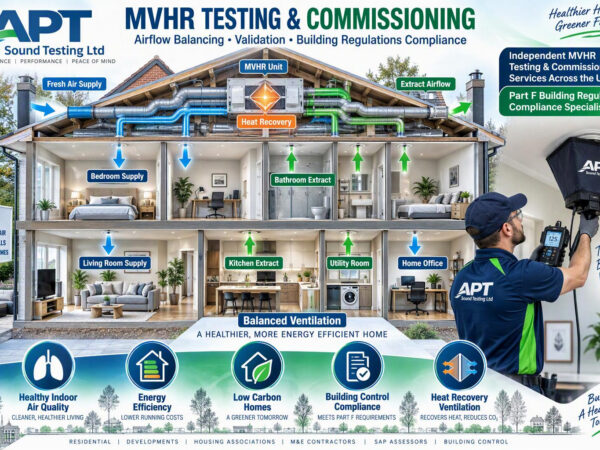
What Happens During an MVHR Flow Rate Test?
An independent ventilation engineer will:
- Inspect the installation.
- Measure airflow rates at every supply and extract valve.
- Balance the system.
- Check boost and background ventilation settings.
- Compare measured airflow rates against design requirements.
- Issue a ventilation test certificate where compliance is demonstrated.
MVHR testing forms an important part of demonstrating compliance with Part F Building Regulations
Further Reading
We recommend the following resources:
Government Guidance
- Approved Document F: https://www.gov.uk/government/publications/ventilation-approved-document-f
- Approved Document F FAQs: https://www.gov.uk/guidance/approved-document-f-volume-1-dwellings-frequently-asked-questions
- Home Ventilation Guidance: https://www.gov.uk/government/publications/home-user-guide-template/existing-home-ventilation-guide
Part F MVHR Vent Test Checklist ▶
Contact APT Sound Testing
APT Sound Testing Ltd provides independent MVHR flow rate testing, ventilation commissioning verification and Part F compliance testing throughout England and Wales.
Our experienced engineers work with developers, housing associations, architects, M&E contractors and self-builders to provide fast turnaround testing and certification for Building Control approval. If you have any question in regards to this MVHR flow testing checklist, please contact us using the details below.
Call: 01525 303905
Email: info@aptsoundtesting.co.uk
Website: https://www.aptsoundtesting.co.uk
