
Do MVHR Systems Need to Be Tested by a Third Party Rather Than the Installer?
Mechanical Ventilation with Heat Recovery (MVHR) systems have become increasingly common in modern homes due to tighter building envelopes, improved energy efficiency standards and growing awareness of indoor air quality and prior to handover, the builder needs to carry out MVHR testing. However, one question we are regularly asked by developers, house builders and homeowners is:
“Does an MVHR system need to be tested by an independent third party, or can the installer commission and certify the system themselves?”
Yes, MVHR systems should be tested by a third party and not the installer. This is to ensure that the system meets the required airflow rates and provides effective whole-house ventilation. The third-party testing is a legal requirement under the Building Regulations and is part of the process to ensure compliance with Approved Document F. The testing involves measuring the airflow at each terminal.
What is an MVHR System?
Mechanical Ventilation with Heat Recovery (MVHR) is a whole-house ventilation system that continuously extracts stale air from wet rooms such as kitchens and bathrooms while supplying filtered fresh air to habitable rooms.
The heat exchanger within the unit recovers heat from outgoing air and transfers it to incoming fresh air, helping improve energy efficiency whilst maintaining healthy indoor air quality.
MVHR systems are particularly common in:
- New build houses
- Apartments
- Passivhaus developments
- Low-energy homes
- Highly airtight buildings
What Does Part F Require when it comes to MVHR Testing?
Part F of the Building Regulations covers ventilation requirements within buildings. The Government’s guidance is contained within Approved Document F, which sets out the requirements for ventilation systems to provide adequate indoor air quality and moisture control. [gov.uk], [assets.pub…ice.gov.uk]
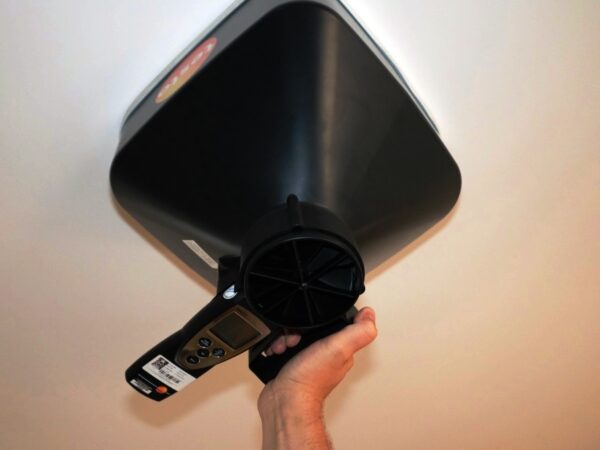
For MVHR systems, airflow rates must be measured and commissioned to demonstrate that the system performs in accordance with the design requirements and Building Regulations.
The commissioning process typically includes:
- Measuring airflow at each terminal
- Balancing supply and extract rates
- Adjusting airflow settings
- Recording final airflow readings
- Producing commissioning documentation
Can the Installer Commission an MVHR System?
In many cases, the installer may carry out the initial commissioning and balancing of the system.
This usually involves:
- Setting airflow rates
- Adjusting valves
- Configuring fan speeds
- Recording commissioning data
- Producing commissioning sheets
A competent installer should always commission the system before handover.
However, there is an important distinction between commissioning and independent verification.
Why Independent MVHR Testing is Often Requested
Many developers and Building Control bodies prefer independent testing because it provides an impartial assessment of system performance.
Independent verification offers several advantages:
Greater Confidence in Compliance
A third-party tester has no involvement in the installation process and therefore provides an unbiased assessment.
Reduced Risk of Errors
Independent testing can identify:
- Incorrect airflow settings
- Wiring faults
- Ductwork restrictions
- Poor balancing
- Installation defects
Additional Quality Assurance
Developers frequently use third-party testing as part of their quality control procedures to ensure systems perform as designed.
Building Control Assurance
Some Building Control officers and warranty providers may request evidence demonstrating that systems have been independently checked.
What Does an Independent MVHR Test Involve?
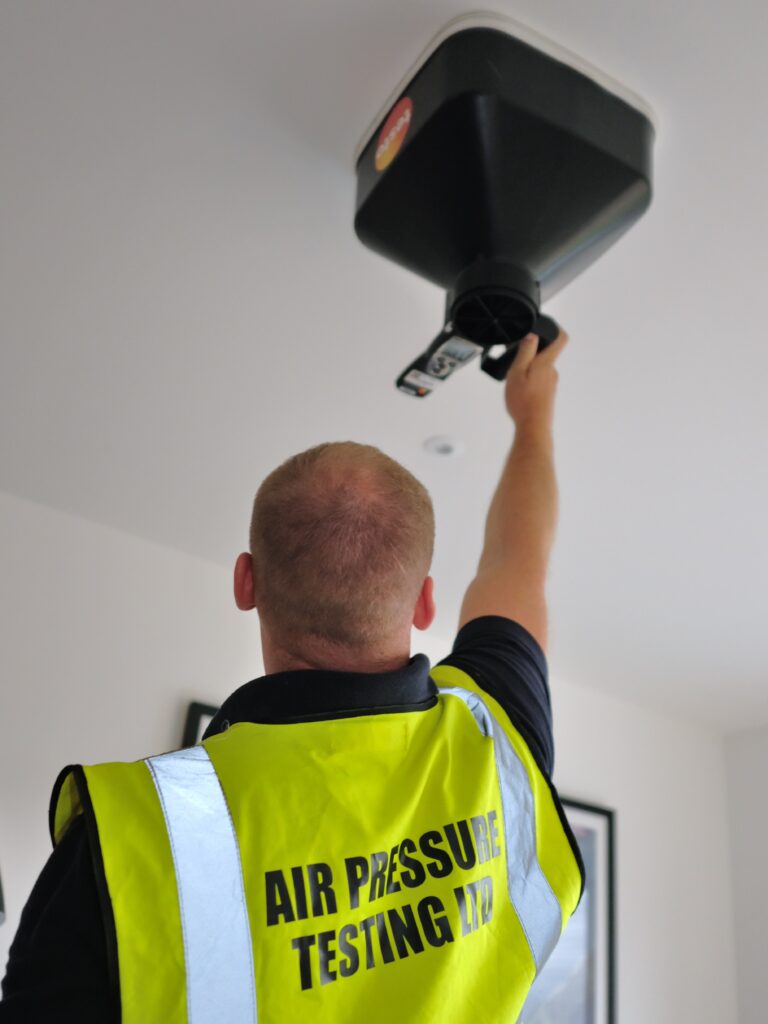
A specialist ventilation engineer will use calibrated airflow measurement equipment to assess the MVHR system.
Testing typically includes:
Airflow Measurements
Airflow is measured at every supply and extract terminal.
These readings are compared against:
- Design airflow rates
- Manufacturer requirements
- Part F performance criteria
System Balancing Review
The engineer will verify:
- Supply air volumes
- Extract air volumes
- Whole-house airflow rates
- System balance
Operational Checks
The following may also be reviewed:
- Boost mode operation
- Controller settings
- Filter condition
- Accessibility for maintenance
Reporting
A detailed report is normally produced showing:
- Design airflow rates
- Measured airflow rates
- Compliance status
- Recommendations (if required)
Common Problems Found During Independent MVHR Testing
Even recently installed systems can experience issues.
Typical examples include:
Incorrect Commissioning Settings
Fan speeds may not match the design specification.
Crushed or Restricted Ductwork
Poor installation can significantly reduce airflow performance.
Unbalanced Airflows
Supply and extract rates may not be correctly balanced throughout the property.
Installation Deviations
Design changes made during construction are not always reflected within commissioning settings.
Electrical Control Issues
Boost functions and control systems occasionally fail to operate as intended.
Please download our comprehensive checklist to help you prepare for the Part F Ventilation Test.
Part F Vent Testing Checklist ▶
Does Building Regulations Part F Specifically Require Third-Party MVHR Testing?
Approved Document F requires MVHR testing to ventilation systems to be commissioned and provides guidance on demonstrating compliance. The guidance supports measuring airflow rates and providing commissioning information.
However, the regulations themselves focus on achieving compliant performance rather than explicitly stating that every MVHR system must always be tested by an entirely separate third-party company.
In practice:
- The installer usually undertakes the initial commissioning.
- Independent third-party verification is often recommended and frequently requested by developers, clients and Building Control bodies.
- Many developers choose third-party testing to reduce compliance risks and provide additional assurance.
Therefore, whilst commissioning is essential, independent testing is often regarded as best practice, particularly on larger developments.
Benefits of Independent MVHR Testing
Developers increasingly favour independent testing because it can:
✅ Improve quality assurance
✅ Reduce Building Control queries
✅ Identify issues before completion
✅ Improve first-time compliance rates
✅ Provide confidence to purchasers
✅ Reduce costly remedial works
✅ Support project sign-off
For larger residential developments, the modest testing cost can often prevent significant delays and contractor return visits.
The Connection between MVHR Testing and Air Tightness Testing
MVHR systems perform best in highly airtight buildings.
For this reason, many projects undertake:
- MVHR Testing and Commissioning
- Air Tightness Testing
- Part F Ventilation Testing
- SAP Calculations
as part of a coordinated compliance strategy.
If a building fails to achieve anticipated airtightness levels, ventilation system performance may not align with design expectations and additional adjustments may be required.
Why Choose APT for Independent MVHR Testing?
APT provides independent ventilation testing services throughout London and the UK.
Our experienced engineers undertake:
- MVHR Testing
- Part F Ventilation Testing
- Air Tightness Testing
- Sound Insulation Testing
- SAP Calculations
- EPC Assessments
Using calibrated airflow measurement equipment, we provide clear, practical advice designed to help developers achieve compliance efficiently and avoid costly delays.
About Darren Helliwell
Darren Helliwell is Director of APT Sound Testing and has more than 20 years of experience helping developers, contractors and housing providers achieve Building Regulations compliance throughout the UK. Darren specialises in Part F Ventilation Testing, Air Tightness Testing, Sound Insulation Testing and Acoustic Consultancy. Having supported projects ranging from individual self-build homes through to major residential developments, Darren is known for providing practical, solution-focused advice that helps clients achieve compliance first time.
Contact APT Today for Part F Ventilation Testing
Need independent MVHR Testing or Part F Ventilation Testing?
✅ Fast Appointments
✅ Nationwide Coverage
✅ Independent Testing
✅ Experienced Engineers
✅ Building Control Accepted Reports
Telephone: 01525 303905
Email: info@aptsoundtesting.co.uk
Website: https://www.aptsoundtesting.co.uk
Contact Us: https://www.aptsoundtesting.co.uk/contact-us/
