
Clients often ask ‘What Types of Sound Insulation Testing is Needed on Flats’? Sound insulation testing is a mandatory requirement for all new‑build and conversion flats under Approved Document E (ADE) of the Building Regulations. The aim is to ensure that separating walls and floors provide adequate protection against airborne and impact noise between dwellings. Whether you’re developing a single flat conversion or a multi‑unit new‑build block, the correct types of sound tests must be carried out before Building Control will sign off the project.
This guide explains the exact types of sound insulation testing required, when they apply, and how to ensure a first‑time pass across London and the South East
Airborne Sound Insulation Testing (Walls & Floors)
Airborne sound tests measure how well a separating wall or floor reduces noise transmitted through the air — such as speech, TV, music and general living noise.
Where airborne sound insulation tests are required
- Between living rooms of adjacent flats
- Between bedrooms of adjacent flats
- Between living rooms and bedrooms
- Across separating floors in both new builds and conversions
How airborne sound insulation testing works
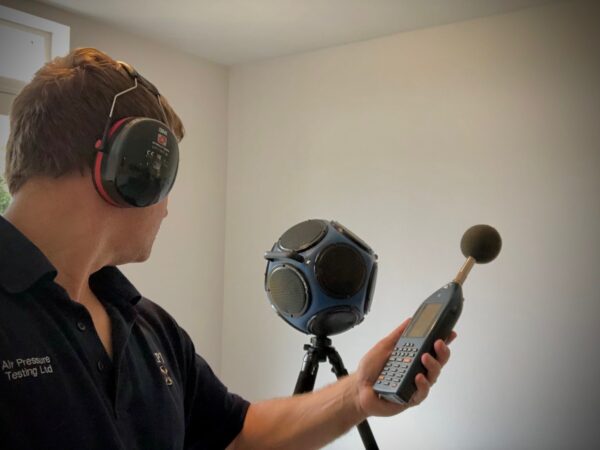
A high‑powered dodecahedron loudspeaker is used to generate pink noise in the source room. Class 1 sound meters measure the sound level in both the source and receiver rooms, and the difference is used to calculate the airborne performance (DnT,w + Ctr).
Minimum performance requirements
- New build: ≥ 45 dB
- Conversions: ≥ 43 dB
If you want a deeper technical breakdown, choose: Airborne sound testing
Impact Sound Insulation Testing (Floors Only)
Impact sound tests measure how well a separating floor reduces footfall and impact noise — such as footsteps, dropped objects or movement across the floor.
Where impact tests are required
- All separating floors between flats
- All conversions where a new dwelling is created above or below another
How impact testing works
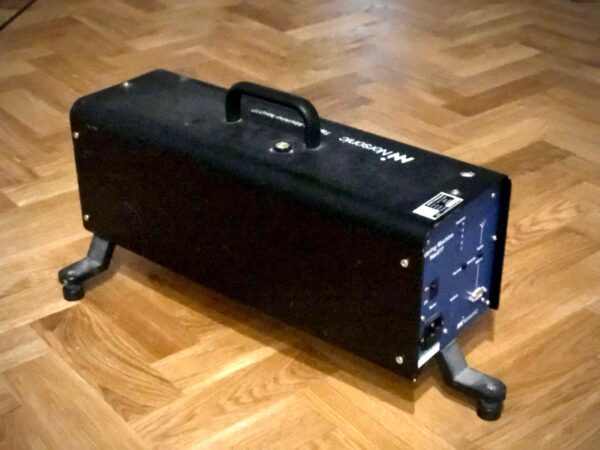
A Norsonic tapping machine is placed on the floor of the upper flat. It drops metal hammers in a controlled pattern while a Class 1 sound meter measure the noise level in the room below.
Minimum performance requirements
- New build: ≤ 62 dB
- Conversions: ≤ 64 dB
For more detail on floor‑related issues, see: Sound Testing Floors in Flats
Sound Testing Requirements for New‑Build Flats
New‑build flats must undergo:
- Airborne wall tests
- Airborne floor tests
- Impact floor tests
Testing is carried out on a sample of separating elements, depending on the number of unit types. Typically, a small block requires:
- 2 airborne wall tests
- 2 airborne floor tests
- 2 impact floor tests
If the building uses Robust Details, testing may not be required — but only if the exact RD specification is followed and registered.
Sound Testing Requirements for Conversion Flats
Conversions are more complex because the existing structure often performs poorly acoustically. All conversions require:
- Airborne wall tests
- Airborne floor tests
- Impact floor tests
Because performance varies widely, we strongly recommend sample sound insulation testing before construction to determine the correct acoustic upgrade strategy.
For design guidance, see: Designing for Sound Insulation
Pre‑ and Post‑Construction Testing
Pre‑construction (sample) testing
Used mainly for conversions to assess the existing performance and design the correct acoustic upgrades.
Post‑construction (pre‑completion) testing
Required for Building Control signoff once the build is complete.
For a full breakdown of the methodology, see: Pre & Post Construction Sound Insulation Testing Methodology
Lease Conditions & Hard Flooring Installations
Many London flats require sound testing for lease conditions, especially where hard flooring (timber, laminate, engineered wood) is being installed. These tests typically include:
- Pre‑installation airborne/impact tests
- Post‑installation verification tests
- Acoustic design advice
See: Sound Testing & Acoustic Design for Lease Conditions
Why Use APT Sound Testing?
APT Sound Testing is one of the UK’s leading acoustic consultancies, offering:
- UKAS‑accredited testing laboratory status
- ATTMA Level 2 certification
- 22 years’ experience in acoustics and sound insulation testing
- Specialist expertise in London and South East developments
- Fast attendance, often within 24–48 hours
- Same‑day certification
- Combined services including air testing, thermal imaging and diagnostic smoke surveys
- In‑house sound test engineers — no subcontractors
Our experience means we can identify issues quickly, provide practical solutions, and help ensure your project passes first time.
Contact Us
For sound insulation testing of flats in London and the South East, or for help with acoustic design:
APT Sound Testing
📧 info@aptsoundtesting.co.uk
📞 07775 623464
🌐 www.aptsoundtesting.co.uk
We can usually attend site within 24–48 hours, and certificates are issued same day.