
The importance of Thermal Imaging for UPS System Reliability in Data Centres cannot be overstaded. The UPS (Uninterruptible Power Supply) is the beating heart of every data centre. It provides the critical bridge between mains power and backup generation, ensuring servers, cooling systems, and network infrastructure remain online during power disturbances. But despite its importance, the UPS is also one of the most common points of electrical failure in data systems. overlooked.
This is where UPS thermal imaging becomes invaluable. By using infrared technology to detect abnormal heat patterns, thermography reveals early‑stage faults that traditional electrical testing cannot identify. In a mission‑critical environment, this insight can be the difference between seamless continuity and a catastrophic outage.
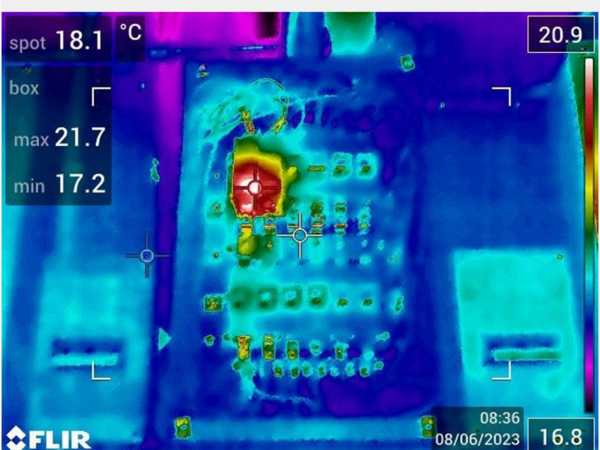
Why UPS Systems Are Vulnerable to Failure
UPS systems operate continuously, often under high load, and contain multiple components that degrade over time. Batteries, capacitors, rectifiers, inverters, and internal connections all experience thermal stress during normal operation. As these components age, they begin to generate excess heat — a clear warning sign of impending failure.
Common UPS failure points include:
- Deteriorating battery cells
- Loose or corroded terminals
- Overheating capacitors
- Imbalanced loads across phases
- Failing internal components
- Poor airflow or blocked cooling paths
The challenge is that these issues rarely produce visible symptoms until the UPS is already compromised. By the time alarms trigger, the fault may already be severe.
How Thermal Imaging to UPS Systems Identifies Problems Early
UPS thermography is performed while the system is live and under load, which is essential for detecting real‑world operating issues. Infrared cameras capture temperature variations across the UPS, highlighting hotspots that indicate electrical or mechanical stress.
Thermal imaging can detect:
- Failing battery blocks showing elevated temperatures
- Loose battery terminals causing resistance heating
- Overloaded output phases leading to uneven thermal distribution
- Overheating capacitors nearing end‑of‑life
- Internal component degradation invisible to the naked eye
- Cooling failures due to blocked vents or fan issues
These thermal anomalies provide early warning signs, allowing engineers to intervene before the UPS fails.
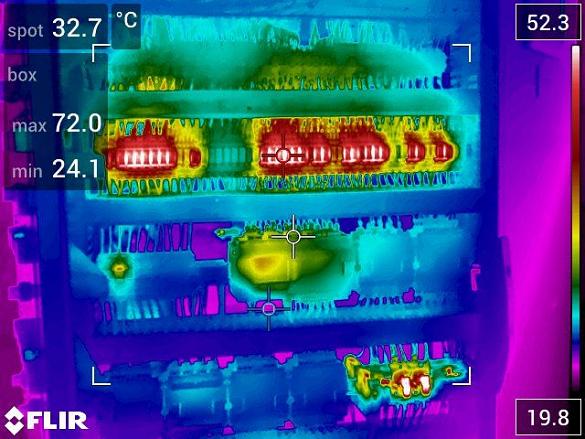
Why UPS Battery Thermography Is Critical
Batteries are the most failure‑prone part of any UPS system. A single failing cell can compromise the entire battery string, reducing runtime and increasing the risk of a full UPS shutdown.
Thermal imaging identifies:
- Hot battery cells
- Imbalanced temperatures across strings
- Poor terminal connections
- Early‑stage thermal runaway indicators
Because batteries degrade gradually, thermography is one of the most reliable ways to track their health over time.
The Cost of UPS Failure in a Data Centre
A UPS failure can trigger:
- Server shutdowns
- Cooling system loss
- Data corruption
- SLA breaches
- Emergency repairs
- Full‑hall outages
With downtime costing £5,000–£15,000 per minute, even a short UPS interruption can have major financial consequences.
Thermography is a low‑cost, high‑impact method of preventing these failures.
Why Thermography Outperforms Traditional UPS Testing
Traditional UPS testing — such as impedance testing or discharge testing — provides valuable data, but it cannot detect heat‑related issues or load imbalance. Thermography inspections fills this gap by offering:
- Real‑time insight under load
- Non‑intrusive testing with zero downtime
- Early detection of hidden faults
- Visual evidence for maintenance planning
Together, these benefits make thermography an essential part of any UPS maintenance strategy.
Reasons to use APT for your Data Centre Thermal Imaging Inspection
We follow a structured process for every Thermal Imaging Survey, beginning with a detailed consultation to understand the specific needs of our clients. This allows us to tailor our approach, ensuring we focus on the areas most relevant to each project. We provide the following premium services:
- Supply of an ITC trained Level 3 thermographer
- We us large format FLIR T Series (640×480 resolution) thermal imaging cameras.
- Comprehensive report to include Introduction and fault cover pages, summary problem pages, elevation inventory,
- Detailed fault documentation pages with possible root cause and remedial recommendation (isotherm included if using equations), baseline IR and DC image of every elevation (100% coverage-no isotherm)
- Application of thermal indexing formulas
- Eco Friendly Email Report within 24 hours
# About the Author
Darren Helliwell is a building performance specialist with over 25 years of hands-on experience leveraging thermal imaging, blower door testing, and smoke analysis to optimise air tightness in both new-build and refurbishment projects such as Battersea Power Station, Imperial War Museum and Harrods.
Using advanced infrared thermal imaging cameras alongside state-of-the-art blower door and smoke-testing equipment, Darren’s team delivers detailed thermographic surveys across residential and commercial buildings. These thermal imaging surveys pinpoint invisible air leaks, identify insulation defects, and reveal thermal bridging—empowering architects, contractors, and property owners to make targeted, energy-saving improvements.
Darren’s ongoing mission is to help design teams and contractors harness the power of thermal imaging to achieve truly airtight, energy-efficient building envelopes. By reducing heat loss and driving down energy bills, his thermography expertise supports sustainable, cost-effective construction and refurbishment outcomes.
Connect with Darren Helliwell:
Email] info@aptsoundtesting.co.uk [LinkedIn] https://www.linkedin.com/in/darren-helliwell-78789b26
Contact us now
For more information our Thermal Imaging Service to Data Centers, please contact Darren on 07775623464 and/or email us at info@airpressuretetsing.co.uk