
There are many reasons why Thermal imaging is essential for modern data centres In today’s digital‑first world, data centres have become the backbone of almost every business operation. As organisations demand more processing power, server rack densities continue to increase and energy consumption rises with them as well as the associated maintenance issues. Many FM managers are unaware that if you don’t have an annual electrical thermal imaging inspection to the critical assets, they may void their buildings insurance in the event if critical failure such as fires etc.
Unmatched Visibility Into Data Centre Heat Patterns
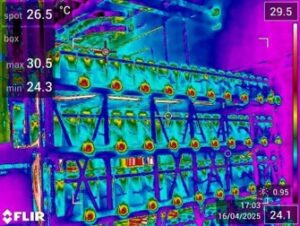
Thermal imaging provides a level of insight that fixed temperature sensors simply cannot achieve. Instead of monitoring isolated points, thermal cameras deliver a complete, real‑time heat map of servers, power distribution units, cooling systems, and the wider facility. This holistic view is essential because hot-spots can form in minutes — often long before conventional monitoring systems detect a problem.
A single blocked vent, failing fan, or overloaded circuit can cause temperatures to rise rapidly, putting critical hardware at risk. With thermal imaging, operators can instantly identify these anomalies and take action before they escalate.
Preventing Hardware Damage and Costly Downtime
Even minor temperature fluctuations can have serious consequences in a high‑density data centre environment. Excess heat accelerates component wear, reduces hardware lifespan, and can trigger automatic throttling that slows down performance. In more severe cases, overheating can lead to unexpected shutdowns or catastrophic equipment failure.
For facilities operating under strict up-time requirements, these risks are unacceptable. Thermal imaging enables early detection, allowing operators to intervene quickly and prevent issues before they lead to costly downtime events.
Supporting Predictive and Proactive Maintenance
One of the greatest advantages of thermal imaging is its ability to support predictive maintenance strategies. By capturing regular thermal scans, operators can track temperature trends over time and identify subtle changes that indicate developing faults.
This proactive approach allows teams to:
-
schedule repairs before failures occur
-
reduce emergency call outs
-
extend the lifespan of critical assets
-
improve overall reliability
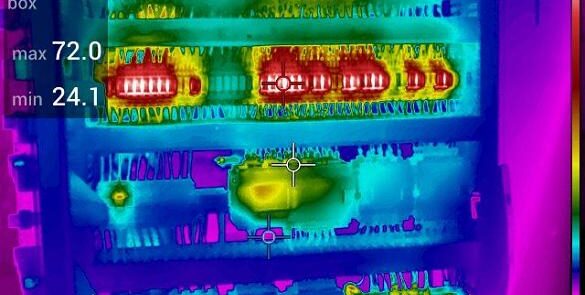
Thermal imaging also helps optimise cooling performance by revealing airflow inefficiencies, re-circulation zones, and areas where cooling is being wasted.
Driving Energy Efficiency and Sustainability via Thermography
As sustainability becomes a priority for data centre operators, thermal imaging plays a vital role in improving energy efficiency. Cooling systems account for a significant portion of a facility’s total energy usage, and even small inefficiencies can lead to substantial waste.
Thermal imaging helps identify:
-
overcooked areas
-
hot-spots
-
airflow imbalances
-
cooling system inefficiencies
By addressing these issues, operators can reduce energy consumption without compromising performance. This supports environmental goals, improves Power Usage Effectiveness (PUE), and helps meet regulatory requirements.
Transforming Data Centre Monitoring and Reliability
Ultimately, the true value of thermal imaging lies in its ability to transform data centre monitoring from reactive to proactive. Instead of waiting for alarms or equipment failures, operators gain continuous insight into the thermal health of their environment.
This empowers data centre teams to:
-
make informed decisions
-
optimise performance
-
reduce operational risks
-
maintain high levels of reliability
In a world where up-time is everything and demand for computing power continues to grow, thermal imaging has become indispensable. It is no longer just a troubleshooting tool — it is a strategic asset that enhances resilience, efficiency, and long‑term operational stability across the entire data centre ecosystem.
Reasons to use APT for your Data Centre Thermal Imaging Inspection
We follow a structured process for every Thermal Imaging Survey, beginning with a detailed consultation to understand the specific needs of our clients. This allows us to tailor our approach, ensuring we focus on the areas most relevant to each project. We also conduct thorough site assessments prior to the survey to identify potential challenges and optimise our inspection routes. This proactive approach helps us maximise efficiency and deliver comprehensive results.
- Supply of an ITC trained Level 3 thermographer
- We us large format FLIR T Series (640×480 resolution) thermal imaging cameras.
- Comprehensive report to include Introduction and fault cover pages, summary problem pages, elevation inventory,
- Detailed fault documentation pages with possible root cause and remedial recommendation (isotherm included if using equations), baseline IR and DC image of every elevation (100% coverage-no isotherm)
- Application of thermal indexing formulas
- Eco Friendly Email Report within 24 hours
# About the Author
Darren Helliwell is a building performance specialist with over 25 years of hands-on experience leveraging thermal imaging, blower door testing, and smoke analysis to optimise air tightness in both new-build and refurbishment projects such as Battersea Power Station, Imperial War Museum and Harrods.
Using advanced infrared thermal imaging cameras alongside state-of-the-art blower door and smoke-testing equipment, Darren’s team delivers detailed thermographic surveys across residential and commercial buildings. These thermal imaging surveys pinpoint invisible air leaks, identify insulation defects, and reveal thermal bridging—empowering architects, contractors, and property owners to make targeted, energy-saving improvements.
Darren’s ongoing mission is to help design teams and contractors harness the power of thermal imaging to achieve truly airtight, energy-efficient building envelopes. By reducing heat loss and driving down energy bills, his thermography expertise supports sustainable, cost-effective construction and refurbishment outcomes.
FAQ for Thermal Imaging for Data Centres
What makes thermal imaging essential for modern data centres?
Thermal imaging provides unmatched visibility into data centre heat patterns by delivering a complete, real‑time heat map of servers, power distribution units, cooling systems, and the wider facility, enabling early identification of hot‑spots that fixed sensors may miss and supporting proactive maintenance to protect critical assets.
How does thermal imaging deliver a real‑time heat map compared with fixed temperature sensors?
Thermal cameras deliver a comprehensive heat map in real time rather than monitoring isolated points, allowing operators to see how temperatures evolve across the whole system and to detect anomalies quickly before conventional monitoring systems notice them.
How can thermal imaging help prevent hardware damage and costly downtime?
By detecting temperature fluctuations and inefficiencies early, thermal imaging helps prevent overheating, reduce component wear, avoid throttling and unexpected shutdowns, and enable quick intervention to avert costly downtime.
What is the role of thermal imaging in predictive and proactive maintenance?
Thermal imaging supports predictive maintenance by tracking temperature trends over time, identifying subtle fault indicators, and enabling scheduled repairs before failures occur, thus extending asset life and improving reliability.
What does the APT data centre thermal imaging inspection process involve?
APT begins with a detailed consultation to tailor the approach, followed by a site assessment to plan inspection routes, then a comprehensive report with fault pages, elevation coverage, isotherm calculations, and thermal indexing; the service uses a Level 3 thermographer and FLIR T Series cameras, and provides Eco Friendly Email Reports within 24 hours.
Connect with Darren Helliwell:
Email] info@aptsoundtesting.co.uk [LinkedIn] https://www.linkedin.com/in/darren-helliwell-78789b26
Contact us now
For more information our Thermal Imaging Service to Data Centres, please contact Darren on 07775623464 and/or email us at info@airpressuretetsing.co.uk