
We often get asked the same questions in regards to what is sound testing? so over the last couple of years we have collated the most common questions and answers which are shown below. As this is quite an extensive Q&A section we have broken it up into 4 articles.
What is precompletion sound testing?
Sound Testing is undertaken towards the end of a development to show that the performance of the party wall and floor partitions meet the standards as stipulated in Building Regulations Approved Document E. The testing methods for airborne and impact sound insulation is in full accordance with the suggested methods presented in BS EN ISO 140-parts 4 & 7: 1998.
What types of buildings need to be sound tested?
Here is a quick breakdown of the types of dwellings/commercial buildings that require sound testing in-line with Building Regulations Part E:
- Houses and flats in compliance with Part E of the Building Regulations.
- Houses & Flats in compliance with the Code for Sustainable Homes.
- Classrooms within schools in compliance with BB93.
- All commercial buildings in compliance with BREEAM.
Are there different types of sound testing?
There are two types of sound testing, airborne and impact. Here is a quick description for each:
Airborne Sound Tests
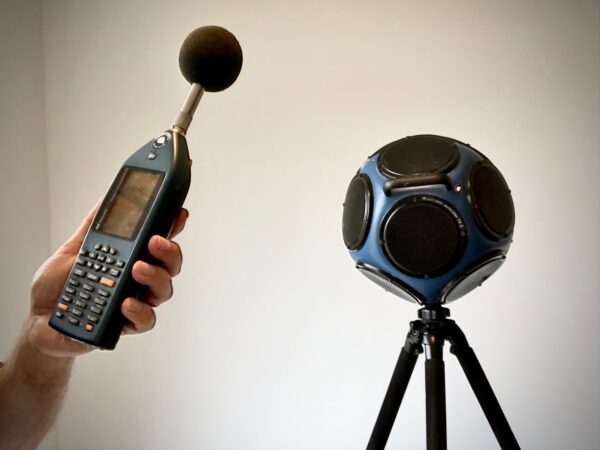
What is Airborne Sound Testing?Airborne sound tests may be required between horizontally and vertically separated pairs of rooms. The sound tests are undertaken by using a sound source, amplifier and loudspeaker to generate a high noise level in one room (the source room). Noise measurements are then taken in both the source and receiver rooms using a prescribed number of source and microphone positions.
Impact Sound Tests
For vertically separated rooms, an Impact sound test may also be required. This sound test is undertaken using a “tapping machine”, (as above) which drops a series of weights onto the floor of the upper room. The noise level in the lower (receiver) room is measured for a prescribed number of source and microphone locations. The background levels in the receiver room are measured and the reverberation time in the receiver room is also measured.
From the results, the impact sound insulation (L’nT,w) is calculated and compared to the requirements of Approved Document E. The background levels in the receiver room are measured and the reverberation time in the receiver room is also measured. From the results, the airborne sound insulation (DnT,w + Ctr) is calculated and compared to the requirements of Approved Document E.
What levels do I need to achieve a sound test pass?
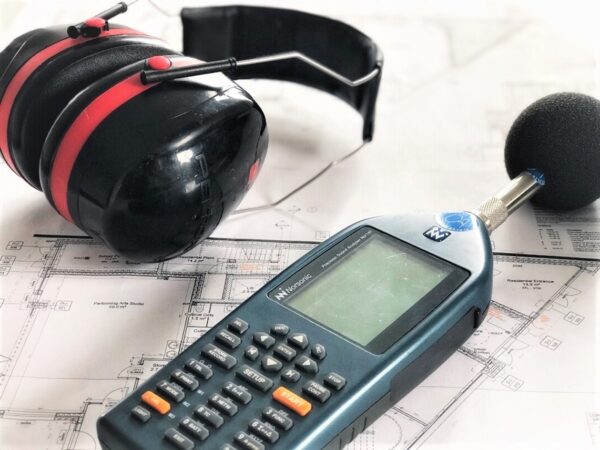
The sound levels required are usually 45dB for airborne wall and floors and 62dB for Impact sound testing. for converted properties the sound levels change to 43dB for airborne wall and floors and 64dB for Impact. the amount of sound tests you require depends on the size of the development.
How many sound tests are required on my project?
All new build properties and conversions require 10% of each party wall/floor construction type to be tested, i.e. if you have 10 flats you would require 1 x 6 pack, this consists of 2 airborne wall, 2 airborne floor & 2 Impact sound tests. However if you have 11 units this would rise to 12 Sound Tests or 2 x 6 pack. If you are complying with code for sustainable homes the standard required may rise between 3-8dB so if you need to comply with more stringent standard, than it’s worth asking us to undertake an acoustic design review. For a small fee you have a peace of mind that the acoustic elements will be robust enough to pass the sound insulation test.
Do houses and flats require different sound testing?
Apartment blocks often require airborne wall, floor and impact sound tests, whereas terrace houses only require airborne wall tests in-line with the requirements of Approved Document E.
Pass your sound testing at the first attempt
Sound insulation design and testing can be quite complicated but we are here to help. Our acoustic consultancy service is a straight forward way to ensure acoustic performance requirements are achieved in compliance with Approved Document E. By considering sound insulation and the acoustic design within your project from the earliest stages you can have confidence that your project is designed to pass its sound testing at the first attempt.
If you would like more information in regards our acoustic design service or sound testing service, please contact us at: info@aptsoundtesting.co.uk or call Darren Direct on 07775 623464.
Alternately, If you would like more information on how to prepare for your sound testing please download our sound test checklist.
About the Author
Darren Helliwell is a building acoustics and compliance specialist with over 25 years of experience helping developers, architects, contractors, housing associations, and property owners achieve compliance with Approved Document E (Part E) of the Building Regulations through professional sound insulation testing, acoustic consultancy, and building performance assessments.
As Director of APT Sound Testing, Darren has overseen thousands of Part E sound tests across residential developments throughout London, the Home Counties, and the wider UK. His expertise spans airborne sound insulation testing, impact sound testing, pre-completion testing, acoustic design reviews, and diagnosing acoustic failures in new-build, conversion, and refurbishment projects.
Working closely with construction teams from the early design stages through to project completion, Darren helps ensure separating walls and floors achieve the required acoustic performance standards. His practical understanding of building acoustics allows him to identify the root causes of noise transfer issues, whether they arise from poor workmanship, inadequate acoustic detailing, flanking sound transmission, or unsuitable floor constructions.
Darren is particularly experienced in supporting developments that require compliance with Building Regulations Part E, including apartment blocks, mixed-use developments, student accommodation, hotels, care homes, and office-to-residential conversions. His extensive knowledge of sound insulation testing requirements, acoustic compliance strategies, and building acoustics best practice enables clients to minimise costly delays and avoid unexpected test failures.
Beyond compliance testing, Darren regularly publishes technical guidance and educational articles covering topics such as airborne sound testing, impact sound testing, acoustic flooring systems, soundproofing solutions, Part E Regulations, floor sound insulation upgrades, and the acoustic challenges associated with replacing carpets with hard floor finishes in apartments. His goal is to help construction professionals better understand acoustic requirements and implement practical, cost-effective solutions that deliver long-term performance.
Through APT Sound Testing, Darren remains committed to improving acoustic standards across the built environment. By combining technical expertise, practical site experience, and a thorough understanding of UK acoustic regulations, he helps create quieter, healthier, and more comfortable buildings while supporting successful Building Control approval.
Connect with Darren Helliwell
Website:
Sound Insulation Testing Services:
Email:
info@aptsoundtesting.co.uk
Telephone:
07775 623464
LinkedIn:
https://www.linkedin.com/in/darren-helliwell-78789b26