
A Complete Guide to Part F Ventilation Compliance for Developers
With modern homes becoming increasingly airtight and energy efficient, ensuring adequate ventilation has become one of the most important aspects of Building Regulations compliance. For developers, understanding Part F of the Building Regulations is essential to avoid costly delays, failed inspections, and problems obtaining Building Control sign-off.
Whether you are constructing a single dwelling, a small housing development, or a large residential scheme, this guide explains what Part F is, why it matters, and how to ensure your project meets all ventilation flow testing requirements first time.
What Is Part F Ventilation Testing for Building Regulations?
Part F of the Building Regulations covers the ventilation requirements for buildings in England. Its primary purpose is to ensure that occupants have access to sufficient fresh air while removing moisture, pollutants, and stale air from the building.
Modern construction methods focus heavily on improving energy efficiency through enhanced insulation and air tightness. While this helps reduce energy consumption and carbon emissions, it can also create problems if adequate ventilation is not provided.
Part F aims to strike a balance between:
- Energy efficiency
- Indoor air quality
- Occupant health
- Moisture control
- Building durability
Without effective ventilation, homes can quickly experience condensation, mold growth and poor indoor air quality.
Why Is Part F Air Flow Testing Important?
Many developers focus heavily on achieving low air permeability results under Part L. However, an airtight building without adequate ventilation can create significant issues for homeowners.
Poor ventilation can cause:
- Condensation on windows
- Dampness within walls and ceilings
- Mould growth
- Excess humidity
- Poor indoor air quality
- Accumulation of airborne pollutants
- Uncomfortable living conditions
Part F ensures that while homes become more energy efficient, they remain healthy environments for occupants.
Which Developments Must Comply with Part F?
Part F applies to a wide range of residential developments, including:
New Build Homes
All new dwellings must demonstrate compliance with ventilation requirements.
Apartment Developments
Flats often require more complex ventilation strategies due to their design and layout.
Housing Association Developments
Social housing providers must ensure every dwelling meets required ventilation standards.
Self-Build Projects
Individual self-builders are also responsible for complying with Part F.
Residential Conversions
Many change-of-use projects and conversions also require ventilation compliance.
What Changed Under the Updated Part F Regulations?
Recent updates to Building Regulations Part F have placed greater emphasis on ventilation performance due to increasingly airtight homes.
Developers are now expected to provide more robust evidence that ventilation systems have been designed, installed and commissioned correctly.
The regulations also place greater importance on:
- Ventilation system commissioning
- Airflow verification
- Occupant information
- System performance testing
As a result, ventilation testing has become a key element of the compliance process.
Types of Ventilation Systems Under Part F
Part F recognises several ventilation strategies.
Background Ventilation and Intermittent Extraction
Traditionally, homes relied upon:
- Trickle vents within windows
- Extract fans in wet rooms
- Natural infiltration through the building envelope
This remains common on many residential developments.
Continuous Mechanical Extract Ventilation (MEV)
MEV systems continuously remove stale air from wet rooms such as:
- Kitchens
- Bathrooms
- Utility rooms
- WCs
Fresh air enters through background ventilators and designed openings.
Mechanical Ventilation with Heat Recovery (MVHR)
MVHR systems both extract and supply air while recovering heat from outgoing air.
Benefits include:
- Improved energy efficiency
- Better indoor air quality
- Reduced heat loss
- Enhanced occupant comfort
These systems are becoming increasingly popular as developers target higher energy performance standards.
What Is Ventilation Testing for Building Regulations Part F?
Ventilation testing is used to verify that installed systems achieve the airflow rates required under Part F.
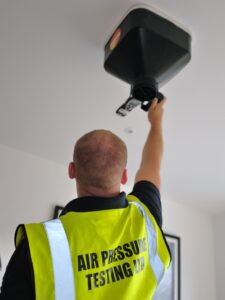
A specialist engineer measures airflow volumes from ventilation terminals throughout the dwelling.
Testing demonstrates that:
- Fans have been correctly installed
- Duct-work performs as designed
- Airflow rates meet regulations
- The ventilation strategy functions effectively
The results are then recorded within a formal test certificate for Building Control.
What Airflow Rates Are Required for Dwellings?
Part F establishes minimum extraction rates for specific rooms.
Typical examples include:
Kitchen Extraction
- 30 litres per second adjacent to a hob
- 60 litres per second elsewhere
Utility Rooms
- 30 litres per second
Bathrooms
- 15 litres per second
WCs
- 6 litres per second
The exact requirements will depend upon the type of ventilation system installed and the property’s overall design. Click below, to download our Part F ventilation testing checklist.
Part F Extract Vent Testing Checklist ▶
How Is Ventilation Testing Conducted?
Testing is usually completed during the final stages of construction when:
- Electrical systems are operational
- Fans have been commissioned
- Duct-work is complete
- Internal finishes are substantially finished
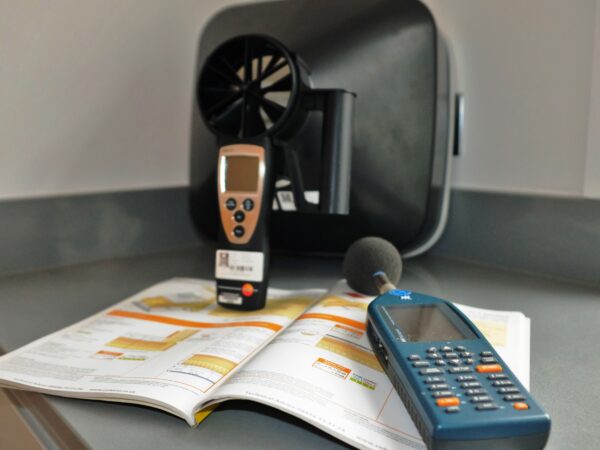
Engineers use calibrated airflow measurement equipment to assess each extract point.
The process typically includes:
Inspection
Reviewing the ventilation design and installation.
Airflow Measurement
Measuring actual airflow rates at each extract terminal.
Compliance Assessment
Comparing results against Part F requirements.
Certification
Issuing compliance documentation for Building Control.
Common Reasons Developments Fail Part F Testing
Ventilation test failures are surprisingly common but are often straightforward to resolve.
Incorrect Fan Settings
Many extract fans are delivered with adjustable performance settings.
Failure to commission these correctly can result in insufficient airflow.
Crushed Flexible Duct-work
Damaged or compressed ducting creates resistance, reducing extraction performance.
Excessive Duct Runs
Long duct routes can significantly impact airflow rates.
Poor External Terminals
Unsuitable grilles and roof terminals can restrict ventilation performance.
Installation Defects
Incorrect connections, air leakage or poorly installed ductwork often reduce system efficiency.
Electrical Commissioning Problems
Incorrect wiring may prevent systems reaching their designed boost speeds.
How Developers Can Avoid Extract Ventilation Failures
Successful projects generally follow a few simple principles.
Consider Ventilation Early
Ventilation design should be integrated during the design stage rather than treated as an afterthought.
Coordinate Multiple Trades
Mechanical contractors, electricians and site management teams should work together throughout installation.
Protect Duct-work During Construction
Ensure ducting remains free from damage caused by other trades.
Commission Systems Properly
Verify all systems are operating at intended settings before the testing engineer arrives.
Undertake Pre-Testing Checks
Identifying issues early can prevent delays at project completion.
How Part F Links with Part L
Part F and Part L are closely connected.
Part L focuses on:
- Energy efficiency
- Carbon reduction
- Air tightness
Part F focuses on:
- Ventilation
- Indoor air quality
- Occupant health
As buildings become more airtight under Part L requirements, the importance of Part F increases significantly.
A highly airtight property without adequate ventilation can experience severe moisture and air quality issues.
For this reason, developers should view both regulations as complementary rather than separate compliance requirements.
Why Choose APT for Ventilation Testing?
APT supports developers, house builders, housing associations and self-builders throughout the UK with fast, reliable ventilation testing services.
Our experienced engineers understand the practical challenges faced during project completion and work closely with site teams to minimise delays and achieve compliance efficiently.
Alongside ventilation testing, APT can also provide:
- Air Tightness Testing
- Sound Insulation Testing
- SAP Calculations
- EPC Assessments
- Acoustic Consultancy Services
By combining multiple compliance services under one provider, we help streamline the Building Regulations process and reduce project administration.
About Darren Helliwell
Darren Helliwell is a Director at APT and has extensive experience supporting developers, contractors and consultants with Building Regulations compliance across the UK.
Having worked on projects ranging from individual self-build homes to major residential developments, Darren specialises in ventilation testing, air tightness testing, sound insulation testing and environmental compliance – the Big 3 testing package. His practical, solutions-focused approach helps clients identify issues early, reduce project risks and achieve Building Control sign-off efficiently.
APT has delivered testing and certification services on thousands of residential units and continues to support some of the UK’s leading developers and contractors.
Contact APT Ventilation Testing
Need Help with Part F Compliance?
Whether you’re constructing a single dwelling or a large residential development, APT can help ensure your project meets all ventilation requirements quickly and efficiently.
✅ Accredited Ventilation Testing
✅ Fast Report Turnaround
✅ UK Coverage
✅ Building Control Accepted Certification
✅ Competitive Fixed Pricing
Call: 01525 303905
Email: info@aptsoundtesting.co.uk
Website: www.aptsoundtesting.co.uk
Get a Fast Quote Today
Contact APT today for professional ventilation testing and expert guidance on meeting Part F Building Regulations requirements.