
Top 10 Reasons Part F Ventilation Tests Fail (And How to Avoid Costly Delays)
Achieving compliance with Building Regulations Part F is a crucial milestone for any residential development. Unfortunately, ventilation test failures remain one of the most common reasons for delays to Building Control sign-off, handover dates, and project completion.
Whether you’re a developer, house builder, ventilation contractor, or homeowner, understanding why ventilation systems fail can save both time and money.
In this guide, we reveal the Top 10 Reasons Ventilation Tests Fail and explain how to avoid common mistakes before your Part F ventilation testing visit.
What Is a Part F Ventilation Test?
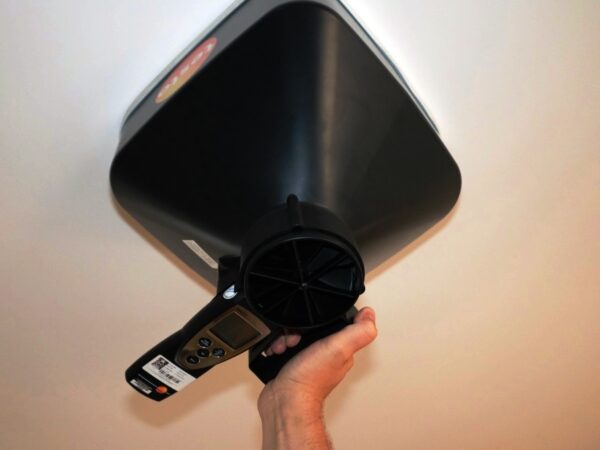
Part F ventilation testing (also known as ventilation commissioning or airflow testing) measures the actual airflow rates achieved by a ventilation system and compares them against the requirements of Approved Document F. Government guidance on ventilation requirements is contained within Approved Document F. [gov.uk], [assets.pub…ice.gov.uk]
Official guidance can be found at:
https://www.gov.uk/government/publications/ventilation-approved-document-f
The purpose of the test is to demonstrate that the property receives adequate ventilation to maintain indoor air quality and reduce the risk of condensation and mould growth.
1. Incorrect Fan Speed Settings
This is by far the most common cause of ventilation test failures.
Many systems leave the factory with default settings that are unsuitable for the completed installation. If boost rates and trickle rates have not been correctly commissioned, airflow rates may fall well below the minimum requirements.
How to Avoid It
- Ensure commissioning has been completed prior to testing.
- Verify boost settings are operating correctly.
- Check all fan controls before the test visit.
2. Crushed or Kinked Flexible Duct-work
Flexible duct-work can significantly restrict airflow when compressed or bent too tightly.
Even a high-performance fan may fail if airflow is restricted by poorly installed duct-work.
Common Issues
- Sharp bends
- Crushed sections
- Excessively long duct runs
- Poor routing
3. Excessive Duct Lengths
Every metre of ducting introduces resistance into the system.
Where duct runs exceed manufacturer recommendations, airflow may not achieve the design rates required for compliance.
Long duct runs are particularly problematic where extract fans serve multiple wet rooms.
4. Poorly Installed Duct Connections
Air leakage within the duct-work network can dramatically reduce airflow at the extract terminals.
Common defects include:
- Loose connections
- Missing seals
- Damaged duct-work
- Unsealed joints
If air escapes before reaching the terminal, the measured flow rate will be lower than expected.
5. Blocked or Restricted Air Valves
Ventilation terminals are frequently left partially covered during construction.
We’ve attended numerous sites where airflow was being restricted by:
- Paint
- Dust
- Protective coverings
- Packaging materials
- Damp-proof membranes
Always check terminals are clean and unobstructed prior to testing.
6. Missing Door Undercuts
Part F compliance relies upon air being able to move freely throughout the dwelling.
Where internal doors have inadequate undercuts, airflow transfer between rooms can be severely restricted.
This is particularly common on:
- Bathroom doors
- Utility room doors
- En-suite doors
Even where the fan itself is operating correctly, restricted airflow pathways can affect overall system performance.
7. Incorrect Terminal Adjustment
Supply and extract valves must often be carefully adjusted during commissioning.
If airflow balancing has not been carried out correctly:
- Some rooms may achieve excessive airflow.
- Other rooms may fall below the minimum requirements.
Professional balancing is particularly important for MEV and MVHR systems.
8. Electrical Controls Not Working Properly
Many ventilation systems fail because boost controls are not functioning correctly.
Typical issues include:
- Faulty humidistats
- Incorrect wiring
- Sensor failures
- Disabled boost switches
The fan may appear operational whilst failing to achieve the required boost airflow rate.
9. Poor MVHR Commissioning
Mechanical Ventilation with Heat Recovery (MVHR) systems require careful balancing to achieve compliance.
Common issues include:
- Incorrect commissioning settings
- Unbalanced supply and extract rates
- Dirty filters
- Incorrect design assumptions
Without proper commissioning, even expensive MVHR systems can fail Part F testing.
10. Ventilation Testing Undertaken Too Early
Ventilation testing is often booked before the installation is fully completed.
Testing should generally take place after:
✅ Electrical systems are commissioned
✅ Ventilation controls are operational
✅ Air valves are fitted
✅ Internal doors are installed
✅ Duct-work is complete
✅ Ceiling finishes are installed
Booking testing too early can result in unnecessary failures and additional testing costs.
Part F Extract Vent Testing Checklist ▶
How to Pass a Ventilation Test First Time
The majority of Part F failures can be avoided by undertaking a simple pre-test inspection.
Before your test visit, check:
- All fans are operational
- Boost functions work correctly
- Duct-work is complete
- Air valves are fitted
- Internal doors are hung
- Door undercuts comply with design requirements
- Filters are clean
- Grilles are unobstructed
Taking these simple steps can significantly increase the likelihood of passing first time.
Why Independent Third-Party Testing Matters
Many Building Control Bodies prefer independent third-party verification of ventilation system performance.
Independent testing provides objective evidence that airflow requirements have been achieved and helps demonstrate compliance with Approved Document F and Building Regulations requirements. [gov.uk], [planningportal.co.uk]
Related Resources
Government Guidance
Approved Document F: https://www.gov.uk/government/publications/ventilation-approved-document-f
Approved Document F (2026 Edition): https://www.gov.uk/government/publications/approved-document-f-2026
Planning Portal Guidance: https://www.planningportal.co.uk/applications/building-control-applications/building-control/approved-documents/part-f-ventilation/
Recommended Reading
- What Is Part F Ventilation Testing?
- Part F Ventilation Testing Cost Guide
- Independent Third-Party Ventilation Testing Explained
- MVHR Commissioning Guide
- Air Tightness Testing Explained
- SAP Calculations for New Build Dwellings
- EPC Requirements for New Homes
Need Part F Ventilation Testing?
Poor commissioning, incorrect fan settings and duct-work installation issues are responsible for the vast majority of failures. APT provides independent ventilation testing and commissioning services throughout England and Wales, helping developers and contractors achieve compliance quickly and efficiently.
✅ Get a Part F Testing Quote
📞 01525 303905
📧 info@aptsoundtesting.co.uk
🌐 https://www.aptsoundtesting.co.uk
About the Author
Darren Helliwell – Director, APT Sound Testing
Darren Helliwell is a Director at APT Sound Testing and has over 20 years of experience delivering building compliance services throughout the UK. He works closely with developers, house-builders, architects, consultants and Building Control departments to help projects achieve compliance with Building Regulations.
His expertise includes:
- Part F Ventilation Testing
- Air Tightness Testing
- Sound Insulation Testing
- Smoke Shaft Testing
- SAP Calculations
- EPC Assessments
- Indoor Air Quality Testing
- Thermal Imaging surveys
APT has supported thousands of successful residential and commercial developments nationwide, providing independent third-party testing, consultancy and certification services.