
Many planning applications fail because the submitted BS8233 noise assessment does not fully comply with the required planning conditions. To help clarify the most frequent issues, we’ve written this article to explain the common reasons why BS8233 noise assessments fail and how these problems can be avoided. A BS8233 noise assessment is a key requirement for many residential and mixed‑use developments, and when completed correctly it demonstrates that internal noise levels will meet the recommended criteria set out in BS8233:2014 – Guidance on Sound Insulation and Noise Reduction for Buildings.
its worth noting that failed noise assessments can lead to planning delays, costly redesigns, or outright refusals. Below we outline the most common reasons why BS8233 noise assessments fail, and how you can avoid these issues on your project.
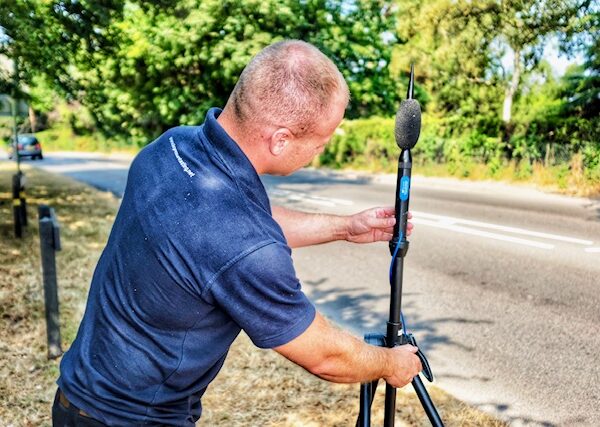
1. Inadequate Baseline BS8233 Noise Monitoring
One of the most frequent causes of failure is poor or incomplete baseline noise monitoring.
Typical issues include:
- Monitoring for too short a duration
- Failing to capture worst‑case noise periods
- Not including night‑time LAmax events
- Incorrect microphone positioning
- Using non‑Class 1 equipment
Local authorities expect robust, representative data collected using UKAS‑calibrated Class 1 instrumentation.
For more detail on survey requirements, see:
👉 BS8233 Noise Surveys
2. Misinterpretation of BS8233 Internal Noise Criteria
Another common reason for failure is incorrectly applying the BS8233 internal noise limits.
Typical mistakes include:
- Applying daytime limits to bedrooms at night
- Ignoring LAmax criteria
- Using outdated guidance
- Not considering room usage (e.g., study vs. living room)
A compliant assessment must apply the correct internal noise targets for each room type.
See our detailed guide:
👉 BS8233 Noise Assessment
3. Incorrect Façade and Glazing Calculations
Even when external noise data is correct, assessments often fail because the façade calculations are inaccurate or incomplete.
Common errors include:
- Using generic glazing values instead of tested Rw ratings
- Ignoring ventilation openings
- Not accounting for flanking paths
- Underestimating required sound insulation performance
A proper BS8233 assessment must model the entire building envelope, not just the windows.
See our façade guidance:
👉 Façade Noise Calculations
4. Ventilation Strategy Not Compatible With BS8233
This is one of the biggest reasons assessments fail.
Developers often specify:
- Standard trickle vents in high‑noise locations
- MVHR systems without acoustic data
- Open‑window assumptions that are unrealistic
- Ventilation rates that conflict with overheating requirements
If the ventilation system allows too much noise ingress, the internal noise targets cannot be met.
See our ventilation guidance:
👉 Acoustic Ventilation Strategies
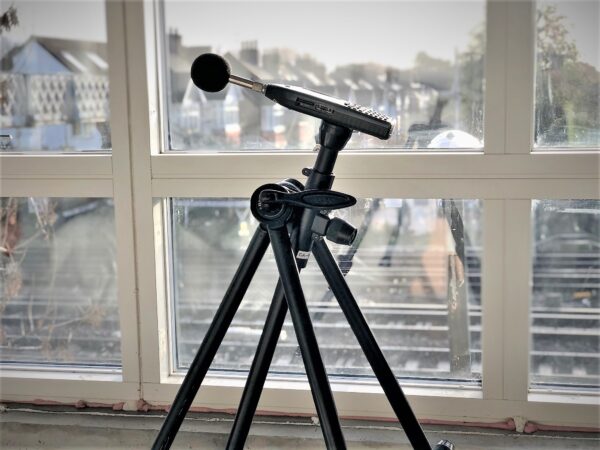
5. Failure to Address LAmax Night‑Time Noise
Many assessments fail because they ignore LAmax events, especially near:
- Railways
- Flight paths
- Busy roads
- Industrial sites with impulsive noise
Even if the LAeq meets BS8233, excessive LAmax levels can cause planning refusal due to sleep disturbance concerns.
6. Weak or Vague Mitigation Recommendations
Local authorities expect clear, evidence‑based mitigation measures.
Assessments often fail because they:
- Provide vague glazing recommendations
- Do not specify ventilation types
- Ignore outdoor amenity noise
- Fail to address balconies, gardens, or communal spaces
A BS8233 report must include specific, actionable design solutions.
7. Reports Not Written to Planning Standards
Even technically correct assessments can fail if the report:
- Lacks clarity
- Does not reference relevant standards
- Fails to justify assumptions
- Is missing calibration certificates
- Does not include raw data or measurement logs
Planning officers need clear, transparent evidence — not generic templates.
Good information for BS8233 Noise Assessments
Strengthen your understanding of BS8233 and planning acoustics with our associated guides:
- BS8233 Noise Surveys
https://aptsoundtesting.co.uk/bs8233-noise-surveys/ - BS8233 Noise Assessment
https://aptsoundtesting.co.uk/bs8233-noise-assessment/ - BS8233 Noise Surveys for New Developments
https://aptsoundtesting.co.uk/bs8233-noise-surveys-for-new-developments/ - Planning Noise Surveys
https://aptsoundtesting.co.uk/planning-noise-surveys/ - Façade Noise Calculations
https://aptsoundtesting.co.uk/facade-noise-calculations/ - Acoustic Ventilation Strategies
https://aptsoundtesting.co.uk/acoustic-ventilation-strategies/
Contact Us
If you need help with a BS8233 noise assessment — or if your previous BS8233 Noise Report has been rejected by the local authority — our UKAS‑accredited team can help.
📞 Call Darren: 07775 623464
📧 Email: info@aptsoundtesting.co.uk
🌐 Website: https://aptsoundtesting.co.uk
We provide fast, accurate and fully compliant BS8233 assessments across England.