
This article helps to explain BS8233 Internal Noise Level Criteria & Acoustic Design Guidance. BS8233:2014 provides essential guidance on internal noise level criteria, façade design, glazing performance and ventilation strategies for new residential and mixed‑use developments. While many planning authorities request a BS8233 Noise Survey or BS8233 Noise Assessment during the planning process, developers often overlook the importance of understanding the actual internal noise limits that must be achieved once the building is occupied.
This guide explains the BS8233 internal noise criteria, how they are applied, and what developers, architects and planning consultants need to consider when designing buildings in noisy environments.
1. What BS8233 Says About Internal Noise Levels
BS8233 sets recommended internal noise limits for different room types, including:
- Living rooms
- Bedrooms
- Dining rooms
- Home offices / study areas
These limits are designed to ensure comfortable living conditions and protect residents from excessive noise caused by road traffic, railways, aircraft, industrial activity and commercial premises.
The standard also provides guidance on:
- Acceptable LAeq levels during daytime and night‑time
- Maximum LAmax levels for bedrooms
- Noise control strategies for façades, glazing and ventilation
- Acoustic design considerations for new developments
For a broader overview of how BS8233 is applied at planning stage, see:
👉 BS8233 Noise Surveys for New Developments
2. Why Internal Noise Criteria Matter for Bs8233 Planning Noise Assessments
Local authorities frequently require BS8233‑compliant noise assessments for:
- New residential developments
- Mixed‑use schemes
- Conversions under Permitted Development
- Developments near transport corridors
- Sites close to commercial or industrial noise sources
Your existing BS8233 overview explains how these surveys support planning applications:
👉 BS8233 Noise Surveys
However, meeting the internal noise criteria is what ultimately determines whether a development is acoustically suitable for residential use.
3. How Internal Noise Levels Are Predicted in BS8233
To demonstrate compliance with BS8233, acoustic consultants typically:
- Measure external noise levels at the site boundary
- Assess the worst‑case façade exposure
- Calculate required sound insulation performance
- Specify glazing and ventilation systems
- Model internal noise levels using BS8233 methodology
A detailed explanation of this process is available here:
👉 BS8233 Noise Assessment
For wider planning‑stage requirements, including WHO and local authority criteria, see:
👉 Planning Noise Surveys
4. Typical Mitigation Measures to comply with BS8233
Where external noise levels exceed BS8233 limits, mitigation may include:
- Enhanced double or triple glazing
- Acoustic trickle vents
- Mechanical ventilation with heat recovery (MVHR)
- Acoustic louvres
- Upgraded façade construction
- Re‑orientation of sensitive rooms
For more detailed guidance on building envelope design, see:
👉 Façade Noise Calculations
And for ventilation design that maintains BS8233 internal noise levels:
👉 Acoustic Ventilation Strategies
5. Why Choose APT Sound Testing for BS8233 Compliance
APT Sound Testing is uniquely positioned to support developers, architects and planning consultants with BS8233 compliance because:
- We are a UKAS‑accredited laboratory
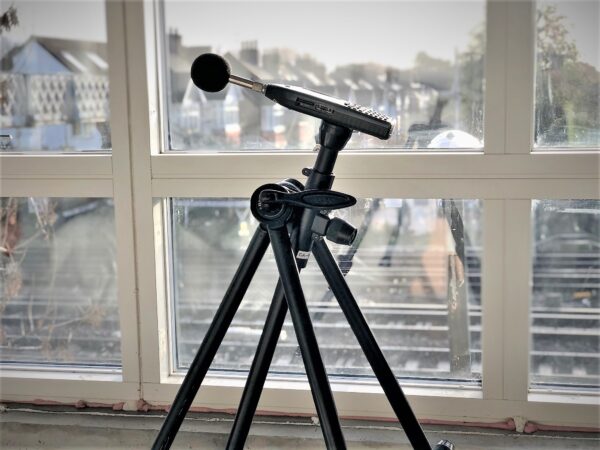
- We use the latest UKAS‑calibrated Norsonic Class 1 acoustic equipment
- We have over 25 years of experience in environmental noise assessment
- We provide fast response times and nationwide coverage
- We produce clear, planning‑friendly reports that local authorities trust
Our consultants regularly undertake BS8233 surveys across London, the South East and the wider UK, supporting everything from small residential conversions to large multi‑unit developments.
Contact Us
If you need help with a BS8233 noise survey, noise assessment or acoustic design advice, our team is ready to assist.
📞 Call Darren directly: 07775 623464
📧 Email: info@aptsoundtesting.co.uk
🌐 Website: https://aptsoundtesting.co.uk (aptsoundtesting.co.uk in Bing)
We provide fast, accurate and fully UKAS‑accredited acoustic testing and consultancy throughout England.