
So what is the most common causes of air test failures in commercial buildings? Air tightness testing is a mandatory requirement for most new commercial buildings under Approved Document L (Part L) of the UK Building Regulations, yet many commercial buildings still fail their first air test, often due to avoidable issues in the building envelope.
Understanding the most common causes of air test failures can help contractors, developers, and building owners avoid costly delays, retesting fees, and compliance problems.
This guide explains the top reasons commercial buildings fail air tightness testing, with links to detailed APT Sound Testing resources to help you diagnose and prevent these issues.
1. Unsealed Service Penetrations
One of the biggest causes of air test failures is poorly sealed penetrations, including:
- Electrical cables
- Plumbing pipes
- HVAC ductwork
- Data cabling
- Fire stopping routes
Even small gaps can create significant leakage in large commercial buildings.
Learn more in our knowledge article: 👉 Air Leakage Paths Found During Thermal Imaging Surveys
2. Poorly Installed Roller Shutter Doors & Loading Bays
Roller shutters and loading bay doors are major leakage points. Common issues include:
- Missing seals
- Damaged thresholds
- Gaps around frames
- Misaligned shutters
These areas often require targeted sealing before testing, to avoid air test failure.
See examples in our blog: 👉 Smoke Leakage Surveys to Pass Air Tightness Testing
3. Leaky Cladding & Façade Junctions
Commercial buildings with metal cladding or curtain walling often fail due to:
- Poorly sealed panel joints
- Gaps at wall‑to‑roof junctions
- Incomplete vapour barriers
- Incorrectly installed insulation
These issues are common in warehouses, retail units, and industrial buildings.
4. Air Leakage Around Windows & Curtain Walling
Window frames, sills, and mullions can leak if:
- Perimeter seals are missing
- Frames are not fully foamed
- Glazing gaskets are damaged
- Curtain walling interfaces are incomplete
These areas should be inspected before the test, to reduce the chance of air test failure
5. Unsealed Internal Risers, Shafts & Voids
Internal leakage paths often connect directly to the external envelope. Common culprits include:
- Lift shafts
- Riser cupboards
- Stairwells
- Ceiling voids
- Plant rooms
These areas must be sealed to prevent uncontrolled airflow.
Learn more in our blog: 👉 Common Air Leakage Paths Identified During Air Tightness Testing
6. Open or Unsealed Ventilation Systems
Before testing, all ventilation systems must be:
- Switched off
- Temporarily sealed
- Dampers closed
- Extract fans isolated
If left open, they create huge leakage paths and guarantee a failed test.
7. Incomplete Wet Trades
Wet trades such as:
- Plastering
- Screeding
- Mastic sealing
…must be fully complete and dry. Wet or unfinished surfaces can distort pressure readings and increase leakage.
8. Gaps in Roof Junctions & Soffits
Roof‑to‑wall junctions are a frequent source of leakage, especially in steel‑frame buildings. Common issues include:
- Missing insulation
- Poorly sealed soffits
- Gaps around purlins
- Unsealed eaves
These areas should be inspected before the test.
9. Poorly Installed Fire Stopping
Fire stopping is essential for safety — but it also plays a major role in air tightness. Common problems include:
- Incomplete fire collars
- Missing intumescent mastic
- Gaps around fire‑rated ductwork
- Poorly sealed risers
10. Lack of Pre‑Test Inspection
Many failures occur simply because the building was not checked properly before the test.
APT Sound Testing offers pre‑test inspections to help identify issues early.
Learn more about the testing process: 👉 Our Air Tightness Testing Procedure
How to Diagnose Air Leakage Quickly
APT Sound Testing provides advanced diagnostic services including:
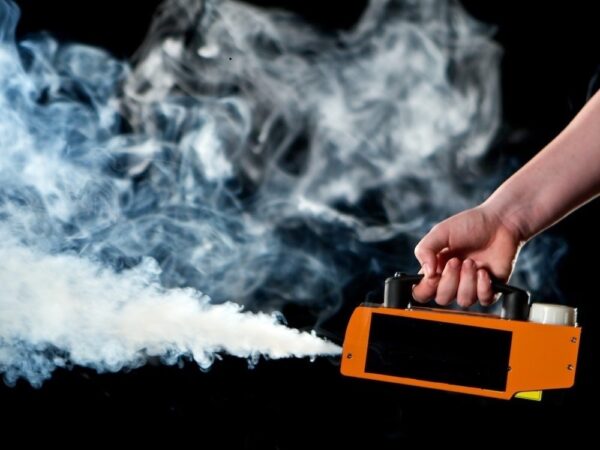
Smoke Testing
Ideal for visualising leakage paths. 👉 Smoke Testing Service
Thermal Imaging Surveys
Perfect for identifying hidden leakage routes. 👉 Thermal Imaging Surveys
AOV Shaft Smoke Testing
For buildings with smoke control systems. 👉 Smoke Testing for AOV Smoke Shafts
How APT Sound Testing Helps You Pass First Time
APT Sound Testing is:
- UKAS‑accredited
- ATTMA Level 2 certified
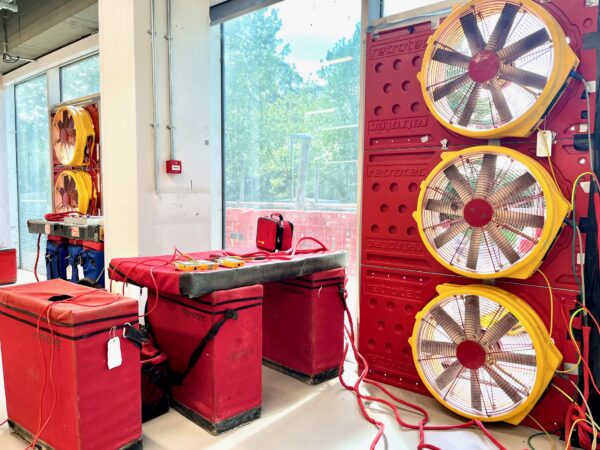
- Equipped with latest modular Retrotec UKAS‑calibrated blower door systems
- Experienced in testing large commercial buildings nationwide
Explore our full service offering: 👉 Air Tightness Testing Services
Accreditations & Technical Competence
APT Sound Testing is a UKAS‑accredited ISO/IEC 17025 testing laboratory specialising in on‑site (field) air tightness testing for commercial and large‑scale buildings. Our accreditation demonstrates that all testing, reporting and quality processes meet the highest technical and procedural standards recognised in the UK.
We are an ATTMA Level 2 registered organisation, qualified to test Large, Complicated and High‑Rise (LCHR) buildings, as well as phased and zonal hand‑over projects. In addition, we are ATTMA EA accredited, enabling us to produce accurate and compliant envelope area calculations for complex commercial structures.
With over 20 years of specialist experience, our engineers have delivered testing and consultancy on some of the UK’s most prestigious and technically challenging developments, including Battersea Power Station and the Imperial War Museum London.
Our combination of accredited competence, deep technical expertise, and long‑standing industry experience ensures that every project receives reliable, repeatable and fully compliant air tightness testing to the highest professional standard.
📞 Contact Us Today
If you want to avoid costly failures and ensure your commercial building passes its air test first time, our expert team is ready to help. Please contact Darren on 07775623464 or email us at info@aptsoundtesting.co.uk