
Commercial Air Tightness Testing Requirements for UK Businesses
(Legal obligations, Part L, and when testing is mandatory)
Commercial air tightness testing is a legal requirement for most new commercial buildings in the UK. It forms a core part of compliance with Approved Document L (Part L) of the Building Regulations, ensuring that buildings meet modern standards for energy efficiency, carbon reduction, and operational performance.
Whether you’re constructing a warehouse, office, retail unit, school, or industrial facility, you must demonstrate that the building meets strict air permeability targets before it can be signed off by Building Control. This guide explains the full set of requirements, when testing is mandatory, and how UK businesses can prepare for a smooth, first‑time pass.
What Is Commercial Air Tightness Testing?
Commercial air tightness testing — also known as air permeability testing or air pressure testing — measures how much air escapes through gaps, cracks, and penetrations in the building envelope. Excessive air leakage leads to:
- Higher heating and cooling costs
- Poor energy performance
- Difficulty meeting Part L
- Uncomfortable internal conditions
- Increased carbon emissions
To understand how leakage paths form, see our knowledge article:
👉 Air Leakage Paths Found During Thermal Imaging Surveys
When Is Commercial Air Tightness Testing Mandatory?
Under Approved Document L2, air tightness testing is mandatory for:
- All new commercial buildings over 500 m²
- Large commercial extensions
- Major refurbishments where the building envelope is significantly altered
Buildings under 500 m² may still require testing if requested by Building Control.
For a step‑by‑step overview of the testing process, visit:
👉 Our Air Tightness Testing Procedure
Understanding Air Tightness Testing for Part L Requirements
Part L sets out the minimum energy‑efficiency standards for commercial buildings. For air tightness, businesses must comply with the following:
1. Target Emission Rate (TER)
The building must not exceed the maximum allowable CO₂ emissions.
2. Air Permeability Target
Most commercial buildings must achieve ≤ 10 m³/h·m² @ 50 Pa, unless the design specifies a lower target.
3. Evidence of Compliance
A valid air tightness test certificate must be submitted to Building Control.
4. Competent Testing Organisation
Testing must be carried out by a UKAS‑accredited provider such as APT Sound Testing.
For more detail on regulatory expectations, see:
👉 Air Tightness Testing for Building Regulations (Part L)
Common Causes of Air Leakage in Commercial Buildings
Commercial buildings often fail due to leakage around:
- Roller shutter doors
- Service penetrations (ducts, pipes, cables)
- Cladding junctions
- Steel frame connections
- Lift shafts and risers
- Poorly sealed door thresholds
We explore these issues in more depth here:
👉 Common Air Leakage Paths Identified During Air Tightness Testing
How to Prepare for a Successful Air Tightness Test
A structured preparation plan helps avoid delays and retesting costs. UK businesses should:
- Seal all service penetrations
- Ensure doors and windows are fully installed
- Close trickle vents
- Complete internal finishes
- Turn off mechanical ventilation
- Arrange a pre‑test inspection for large or complex buildings
For large commercial buildings, APT Sound Testing can also provide smoke testing to visually identify leakage paths:
👉 Smoke Leakage Surveys to Pass Air Tightness Testing
And for AOV shafts:
👉 Smoke Testing for AOV Smoke Shafts That Have Failed the Air Test
What Happens During the Air Tightness Test?
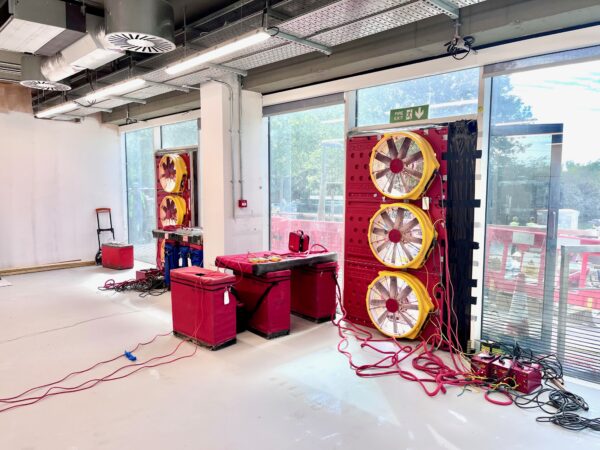
A high‑capacity blower door system is installed at a suitable entrance. The building is then pressurised and depressurised to measure airflow through the envelope. The result is expressed as:
m³/h·m² @ 50 Pa
(cubic metres of air leakage per hour, per square metre of envelope area)
If the building meets or exceeds the design target, a certificate is issued immediately.
For a full breakdown of the process, see:
👉 Our Air Tightness Testing Procedure
What If the Building Fails the Part L Air Test ?
If the building does not meet the required air permeability rate:
- The building cannot be signed off
- Remedial sealing work is required
- Retesting may be needed
- Project delays and extra costs can occur
APT Sound Testing can provide on‑site diagnostics, including smoke tracing and thermal imaging, to quickly locate and fix leakage paths.
Explore our service pages:
👉 Smoke Testing Service
👉 Thermal Imaging Surveys
Why Air Tightness Matters for UK Businesses
Achieving a strong air tightness result provides:
- Lower operational energy costs
- Improved EPC ratings
- Better thermal comfort
- Reduced carbon emissions
- Faster Building Control approval
- Enhanced long‑term asset value
With rising energy prices, air tightness is no longer just a compliance requirement — it’s a financial advantage.
How APT Sound Testing Supports Commercial Clients
APT provides:
- UKAS‑accredited commercial air tightness testing
- High‑capacity blower door systems for large buildings
- Smoke leakage diagnostics
- Thermal imaging surveys
- Pre‑test inspections and consultancy
- Nationwide coverage
Explore our full service offering here:
👉 Air Tightness Testing Services
Accreditations & Technical Competence
APT Sound Testing is a UKAS‑accredited ISO/IEC 17025 testing laboratory specialising in on‑site (field) air tightness testing for commercial and large‑scale buildings. Our accreditation demonstrates that all testing, reporting and quality processes meet the highest technical and procedural standards recognised in the UK.
We are an ATTMA Level 2 registered organisation, qualified to test Large, Complicated and High‑Rise (LCHR) buildings, as well as phased and zonal hand‑over projects. In addition, we are ATTMA EA accredited, enabling us to produce accurate and compliant envelope area calculations for complex commercial structures.
With over 20 years of specialist experience, our engineers have delivered testing and consultancy on some of the UK’s most prestigious and technically challenging developments, including Battersea Power Station and the Imperial War Museum London.
Our combination of accredited competence, deep technical expertise, and long‑standing industry experience ensures that every project receives reliable, repeatable and fully compliant air tightness testing to the highest professional standard.
📞 Contact Us Now
APT Sound Testing is a UKAS‑accredited testing laboratory and an ATTMA Level 2 certified air‑tightness testing provider, giving you complete confidence that your commercial building will be tested to the highest industry standards.
We use the latest modular, UKAS‑calibrated blower door systems, capable of testing everything from small commercial units to large warehouses and complex multi‑storey buildings. Our advanced diagnostic tools — including smoke tracing and thermal imaging — ensure fast, accurate identification of air leakage paths so your project passes first time.
👉 Contact us today at info@aptsoundtesting.co.uk or call Darren on 07775623464 to book your commercial air tightness test and ensure full compliance with UK Building Regulations.